In the world of custom builds and “Inspirational Garage” mentorship, the transmission is often the most misunderstood part of the car. Many beginners treat transmission fluid like engine oil—thinking “as long as it’s full, it’s fine.”
The Truth: Using the wrong transmission fluid is the fastest way to turn a $5,000 gearbox into a $6,000 boat anchor.
1. Why “One Size” Does NOT Fit All
Unlike engine oil, which primarily lubricates and cools, transmission fluid is a hydraulic fluid. It carries the pressure that physically moves the clutches and gears.
- Viscosity Matters: Modern transmissions (8, 9, and 10-speeds) use “Ultra-Low Viscosity” (ULV) fluids to save fuel. Putting old-school, thick Dexron III in a 10R80 Ford transmission will cause the pumps to work too hard, leading to sluggish shifts and eventual pump failure.
- Friction Modifiers: This is the “secret sauce.” Different fluids have different “stickiness.” If a fluid is too slippery, your clutches will slide and burn up; if it’s too “grabby,” the car will shudder and jerk.
2. The Four Major Families
| Fluid Category | Typical Vehicles | The “Big Risk” |
| Traditional ATF (Dexron VI / Mercon LV) | Modern GM, Ford, RAM trucks and SUVs. | Using old-school high-viscosity fluid in these “Low Viscosity” systems causes overheating. |
| CVT Fluid (Continuously Variable) | Nissan, Honda, Toyota, Subaru (daily drivers). | DO NOT MIX. Putting regular ATF in a CVT will destroy the belt/pulley system within miles. |
| DCT Fluid (Dual-Clutch) | Performance cars (VW, Audi, Porsche, Corvette). | These require high heat stability for “wet clutches.” Wrong fluid = “Clutch Shudder” and expensive computer errors. |
| Type F / Old School | Pre-1980 Fords, Drag Racing builds. | These have no friction modifiers. They are designed to “grab” hard. Using this in a modern car will make it shift like a sledgehammer. |
3. The “Lifetime Fluid” Myth
Many modern manufacturers claim their transmission fluid is “Lifetime.”
The Pro Tip: In the industry, “Lifetime” usually means “the life of the warranty” (about 100,000 miles).
For anyone doing “custom fabrication” or heavy-duty work (towing, hauling, or track days), that fluid is usually “done” by 60,000 miles. Heat kills the additives, and once those additives are gone, the metal starts grinding.
How to Identify What You Need
- Check the Dipstick: On older cars, the fluid type is often stamped directly onto the metal of the transmission dipstick.
- The Owner’s Manual: This is the only “Bible” for fluid. Even two cars of the same year and model might have different transmissions (e.g., a 6-speed vs. an 8-speed).
- The “Paper Towel” Test: Drip some fluid on a white paper towel.
- Bright Red: Healthy.
- Light Brown: Needs a change soon.
- Dark Brown/Black with a Burnt Smell: The clutches are already wearing out; a fluid change might actually make it start slipping.
Summary for JayByrd / Dream Factory
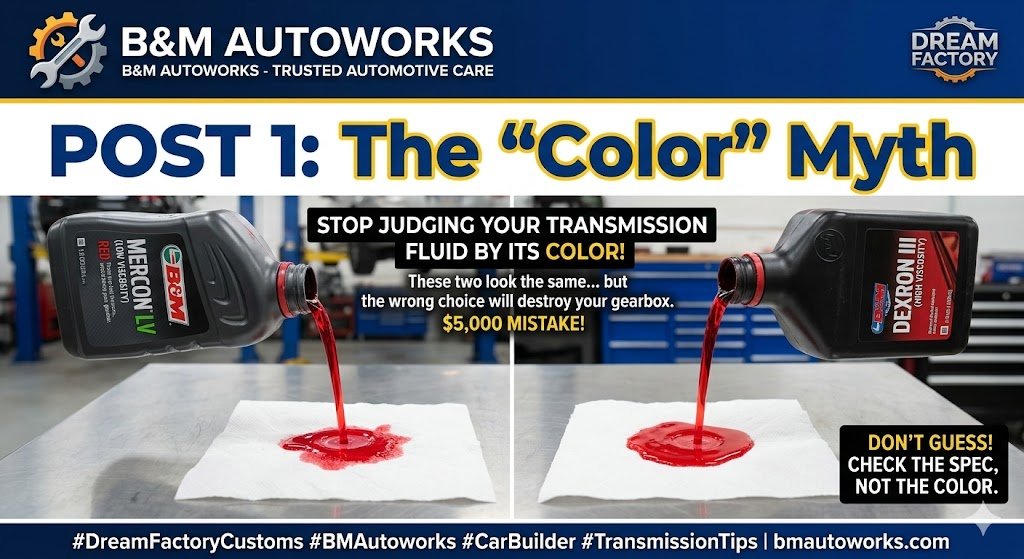
When teaching beginners, emphasize that color is not a specification. Just because it’s red doesn’t mean it’s right. Always match the Spec Number (e.g., Mercon LV, Dexron HP, or ZF 8-Speed) exactly.