There is nothing worse than building a killer sound system, waiting for the beat to drop, and watching your headlights dim to the rhythm of the music. It looks amateur, and it’s dangerous for your equipment.
Low voltage kills amplifiers. When your amp can’t get the power it needs, it clips, overheats, and eventually blows your expensive subwoofers.
The two most common “fixes” people throw at this problem are Capacitors and Extra Batteries. But they do completely different things. Here is how to know which one you actually need.
1. The Capacitor: The fast-acting “Band-Aid”
Think of a capacitor like a small bucket of water right next to a fire. It can dump water instantly, but it runs out just as fast.
• How it works: A capacitor stores a small amount of power and releases it incredibly fast—much faster than a battery can. It is designed to fill in those tiny split-second gaps when a kick drum hits and your voltage dips for a millisecond.
• Is it worth it? Honestly? For 90% of big builds, NO. * If your headlights are dimming hard, a capacitor won’t fix it. A capacitor does not create power; it just stores what your alternator gives it. If your alternator is weak, the capacitor just becomes one more thing for it to charge. It’s a burden, not a solution.
• When to use it: Only on mild systems (under 1,000 watts) that have a very slight flicker. It cleans up the power, but it won’t save a dying electrical system.
2. The Extra Battery: The “Reserve Tank”
Think of a battery like a massive water tank. It can’t dump water as fast as the bucket (capacitor), but it holds way more of it.
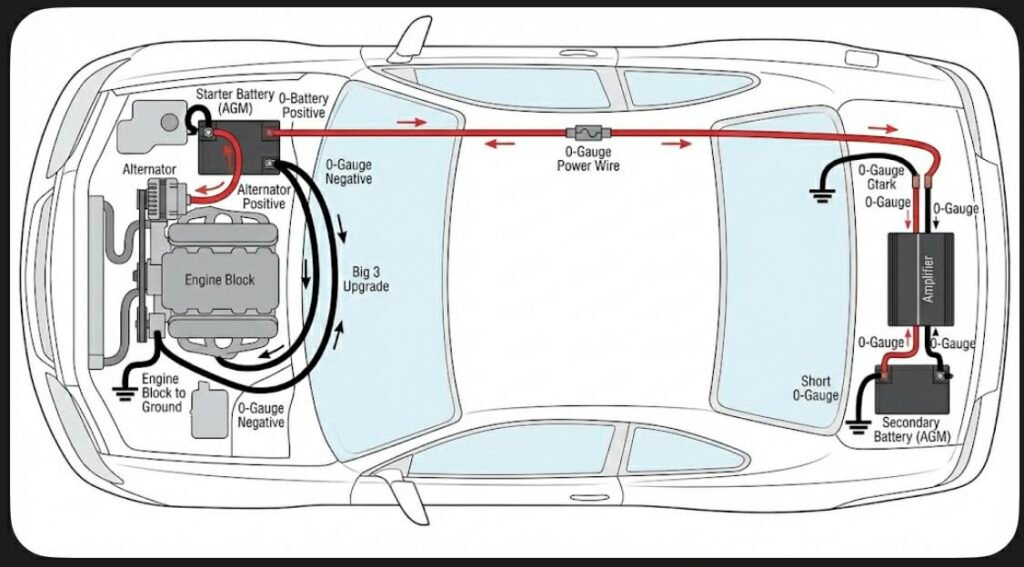
• How it works: When your amplifier tries to pull 200 amps of current for a long bass note and your stock alternator can only supply 100 amps, the extra battery steps in to provide the rest. It keeps the voltage from crashing into the basement.
• Is it worth it? YES. If you are running over 1,500 watts, adding a second battery near the amplifier is almost mandatory.
3. The “Big 3” Upgrade (The Real Secret)
Before you buy a cap OR a battery, you have to do the Big 3 Upgrade. This means replacing three key factory wires with thick 0-Gauge cable:
1. Alternator Positive to Battery Positive.
2. Battery Negative to Chassis Ground.
3. Engine Ground to Chassis Ground.
If you haven’t done this, you are trying to suck a milkshake through a coffee stirrer. Upgrade your wires first!
The Best Battery Type: AGM vs. Lithium
So you decided to get a battery. Which one?
• Flooded Lead Acid (Standard Car Battery): Garbage for car audio. They spill, they fume, and they discharge too slowly. Avoid these for your secondary battery.
• AGM (Absorbent Glass Mat): The Standard Choice. Brands like XS Power or Optima. They are sealed, safe to mount inside the car, and discharge much faster than standard batteries. They are reliable and relatively affordable.
• Lithium (LTO / LiFePO4): The King. If you have the budget, Lithium is the future. A tiny Lithium battery can output the same power as three massive AGM batteries that weigh 80lbs each. They hold a higher resting voltage (around 13-14 volts vs AGM’s 12.6), meaning your amps always make maximum power.
The Verdict
• Skip the Capacitor unless you just like how it looks or have a very minor flicker.
• Do the “Big 3” wiring upgrade first. https://amzn.to/3OeJiii
• Buy an AGM Battery if you are on a budget and want a reliable daily system. https://amzn.to/4tBWKNk
• Buy Lithium if you are chasing numbers and want the absolute best performance money can buy.