By Dream Factory Garage
Welcome to the garage, where we keep the grease under our nails and the classic steel on the road. For the new generation of builders stepping into the world of Chevy small blocks and big blocks, the “Tranny Talk” can get confusing fast.
If you’re staring at a pile of parts or browsing Marketplace, you need to know exactly what you’re looking at. Today, we’re breaking down the Big Three: the TH350, the TH400, and the 700R4.
1. The TH350: The All-Around Workhorse
The Turbo-Hydramatic 350 is the quintessential classic transmission. It’s a 3-speed automatic that’s lightweight, relatively compact, and can handle a surprising amount of power with a simple shift kit.
- Who needs it? The weekend cruiser. If you have a mild street car and don’t plan on hitting the drag strip every Friday or driving 80 MPH on the interstate for hours, this is your best friend.
- The Downside: No overdrive. Your engine will be screaming at high RPMs on the highway.
- How to Identify:
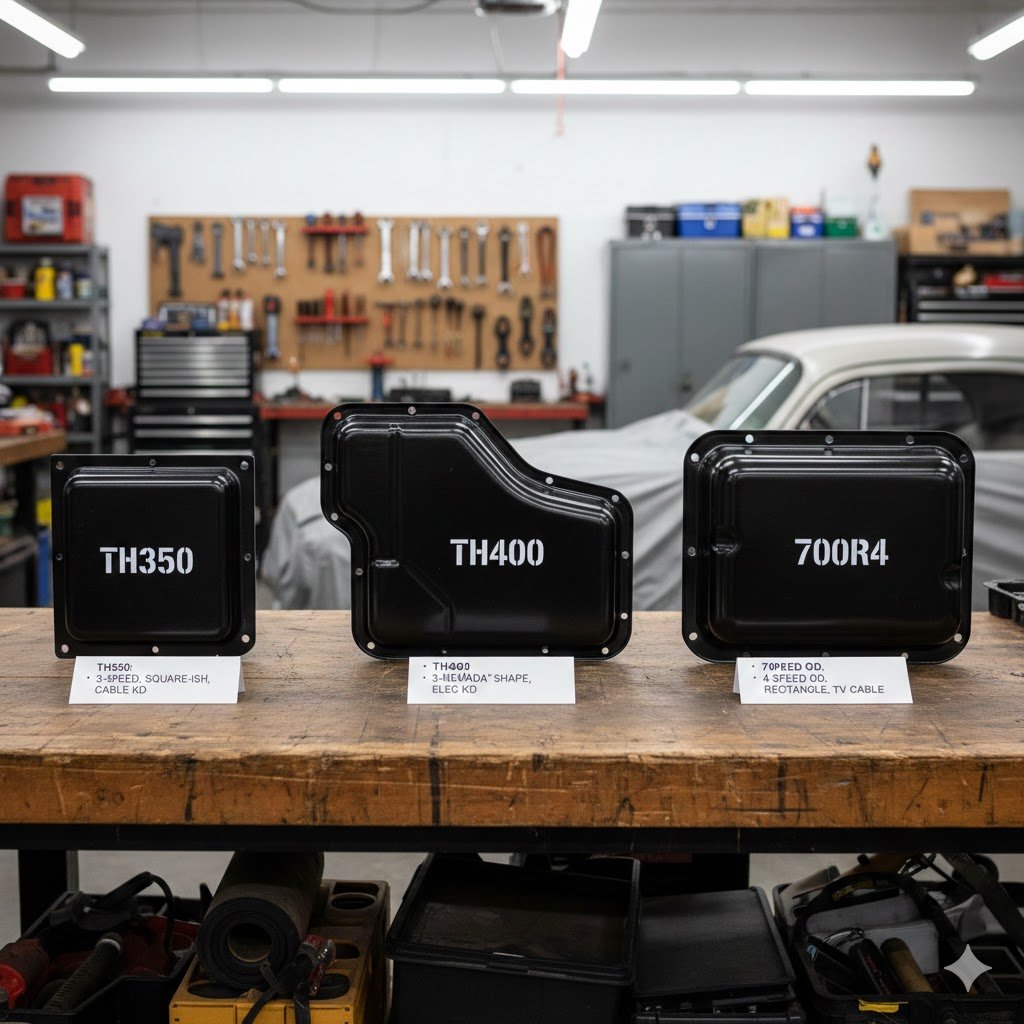
- Shape: The pan is nearly square but has one corner cut off (the passenger-side rear corner).
- The Modulator: Look for a vacuum modulator (a small metal canister) on the back of the case.
2. The TH400: The Bulletproof Beast
If the TH350 is a workhorse, the Turbo-Hydramatic 400 is a tank. It’s a 3-speed automatic built for high-torque big blocks and heavy-duty trucks.
- Who needs it? The Power Player. If you’re pushing serious horsepower or building a heavy truck that’s going to work hard, the 400 is the gold standard. It’s physically larger and heavier than the 350.
- The Downside: Like the 350, it has no overdrive. It also saps a little more “parasitic” power from the engine because of its heavy internal components.
- How to Identify:
- Shape: The pan looks like an irregular state map (some say it looks like an outline of Nevada). It is much larger and more oblong than the 350.
- No Kickdown Cable: Unlike the others, the TH400 uses an electrical switch for kickdown, so you won’t see a cable running to the carburetor/throttle body.
3. The 700R4: The Highway King
The 700R4 changed the game in the 80s by adding a 4th gear—Overdrive.
- Who needs it? The Long-Distance Driver. If you want to take your hot rod on a Power Tour or just want to cruise at 75 MPH without burning a hole in your wallet (or your engine), you need the 700R4. That 0.70:1 overdrive ratio drops your RPMs significantly.
- The Downside: It requires a very specific TV (Throttle Valve) cable setup. If you don’t adjust this cable perfectly, you can burn the transmission up in a matter of miles.
- How to Identify:
- Shape: The pan is a large rectangle. It’s longer than the TH350 pan.
- Length: The overall case is noticeably longer than a TH350.
- The Plug: Look for a 4-pin electrical connector on the driver’s side—this is for the lock-up torque converter.
Quick ID Chart
| Feature | TH350 | TH400 | 700R4 |
| Gears | 3-Speed | 3-Speed | 4-Speed (Overdrive) |
| Pan Shape | Square with one corner cut | Large, irregular “Nevada” shape | Large Rectangle |
| Best For | Budget Street Cruisers | Big Blocks / High Torque | Highway / Fuel Economy |
| Kickdown | Cable | Electric | TV Cable (Critical!) |
Dream Factory Tip: Before you buy, always check the output shaft spline count to make sure your driveshaft will fit. Keep building, keep learning, and keep the culture alive.