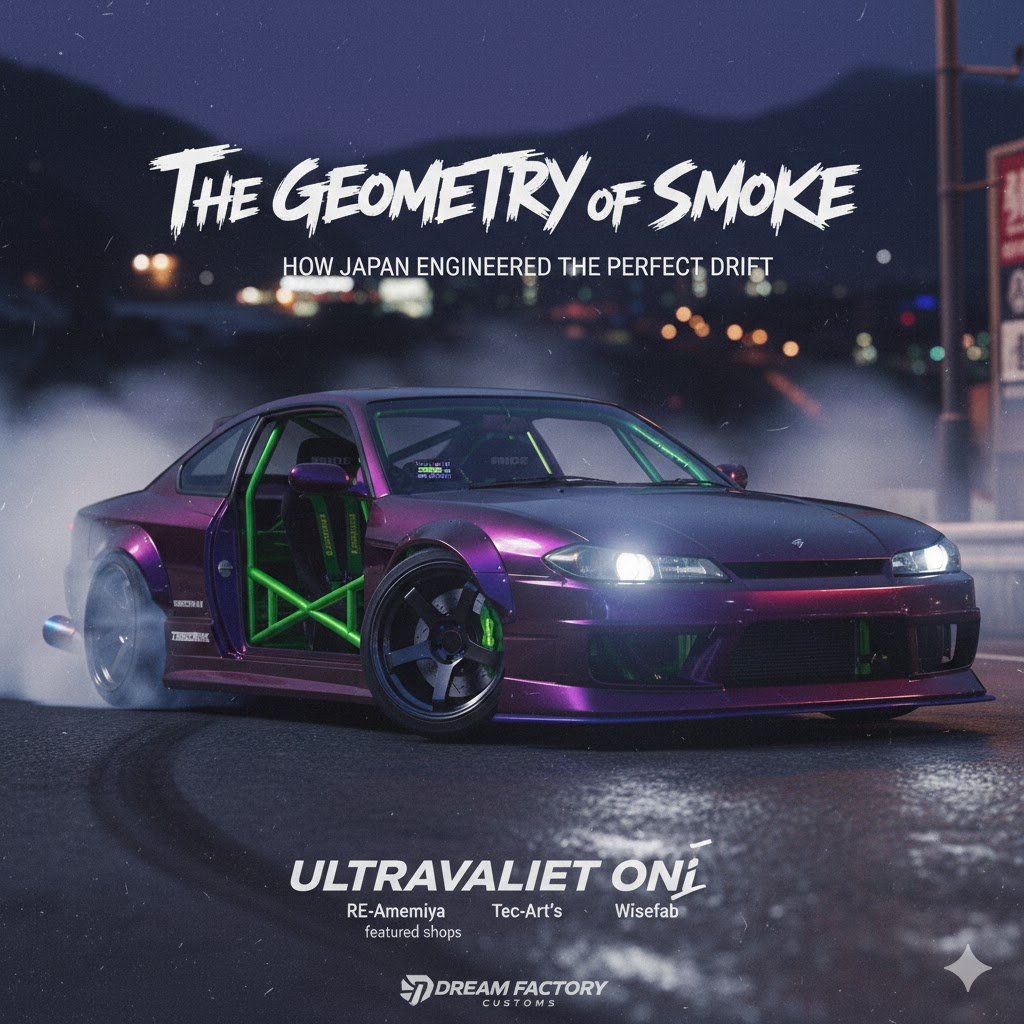
In the West, speed is often measured in a straight line or by the ticking of a stopwatch. But in the mountains of Japan, a different kind of metric emerged in the 1980s: Style. Drifting isn’t just about getting from point A to point B; it’s about the violence and grace of the journey in between. To the Japanese “Shokunin” (master craftsman), a car is a brush, the asphalt is a canvas, and the smoke is the art.
1. The Touge: Where Legend Meets Gravity
Before it was a multi-million dollar global sport, drifting was a survival tactic. On the Touge—the narrow, serpentine mountain passes of Gunma and Nagano—drivers like the legendary Kunimitsu Takahashi began using controlled oversteer to carry more speed through hairpins.
But it was Keiichi Tsuchiya, the “Drift King,” who turned a racing technique into a subculture. Driving his iconic Toyota AE86, Tsuchiya proved that you didn’t need 1,000 horsepower to be a king. You needed balance. The AE86, with its meager $128$ hp $1.6L$ 4A-GE engine, became the “Godfather” of the scene because its lightweight chassis ($53:47$ weight distribution) allowed the driver to feel every vibration of the tires breaking loose.
2. The Holy Trinity of Drift Chassis
Japanese manufacturers in the 90s inadvertently created the perfect drift machines. Three names still dominate every track from Ebisu Circuit to Irwindale:
- The Nissan Silvia (S13/S14/S15): The “S-Chassis” is the undisputed champion. Its multi-link rear suspension and the legendary SR20DET turbo engine allowed for a “predictable snap.” When you throw a Silvia into a corner, it doesn’t fight you—it dances with you.
- The Mazda RX-7 (FD3S): The “Rotary Rocket.” By placing the 13B twin-rotor engine behind the front axle, Mazda achieved a “front-midship” layout. This gives the car a low polar moment of inertia, meaning it spins and recovers with the precision of a figure skater.
- The Toyota Chaser (JZX100): For those who wanted to drift with three friends in the car. This 4-door executive sedan houses the 1JZ-GTE, an engine so over-engineered it can handle double its factory power without breaking a sweat. It’s the “Drift Taxi” that brought heavyweight muscle to the mountains.
3. Geidō: The Philosophy of Mastery
Drifting is the modern expression of Geidō, a 700-year-old Japanese philosophy of traditional arts. It breaks mastery into three stages:
- Shu (Protect): Learning the fundamentals by mimicking the masters (learning to “doughnut” in a parking lot).
- Ha (Detach): Breaking the rules to find your own style (modifying your suspension to suit your specific “flick”).
- Ri (Leave): Transcending the technique to become one with the machine.
This is why Japanese builds are so meticulous. A builder doesn’t just slap on a “Big Angle Kit” from a catalog. They tune the Ackermann geometry of the steering so the inner and outer wheels track perfectly during a 60-degree slide.
4. The Temples of Tuning
If drifting is a religion, shops like RE-Amemiya and Tec-Art’s are its cathedrals.
- RE-Amemiya took the “street-legal” RX-7 and turned it into a GT-spec monster that dominated the D1 Grand Prix.
- Tec-Art’s became the sanctuary for the AE86, proving that with modern carbon-fiber driveshafts and individual throttle bodies (ITBs), a 40-year-old Corolla can still out-smoke a modern supercar.
The Final Shift
Drifting taught the world that a car’s “limits” are just the beginning of the fun. Whether it’s a Midnight Purple Silvia or a battle-scarred Chaser, the Japanese build philosophy remains the same: Engineer the machine to be an extension of the soul.
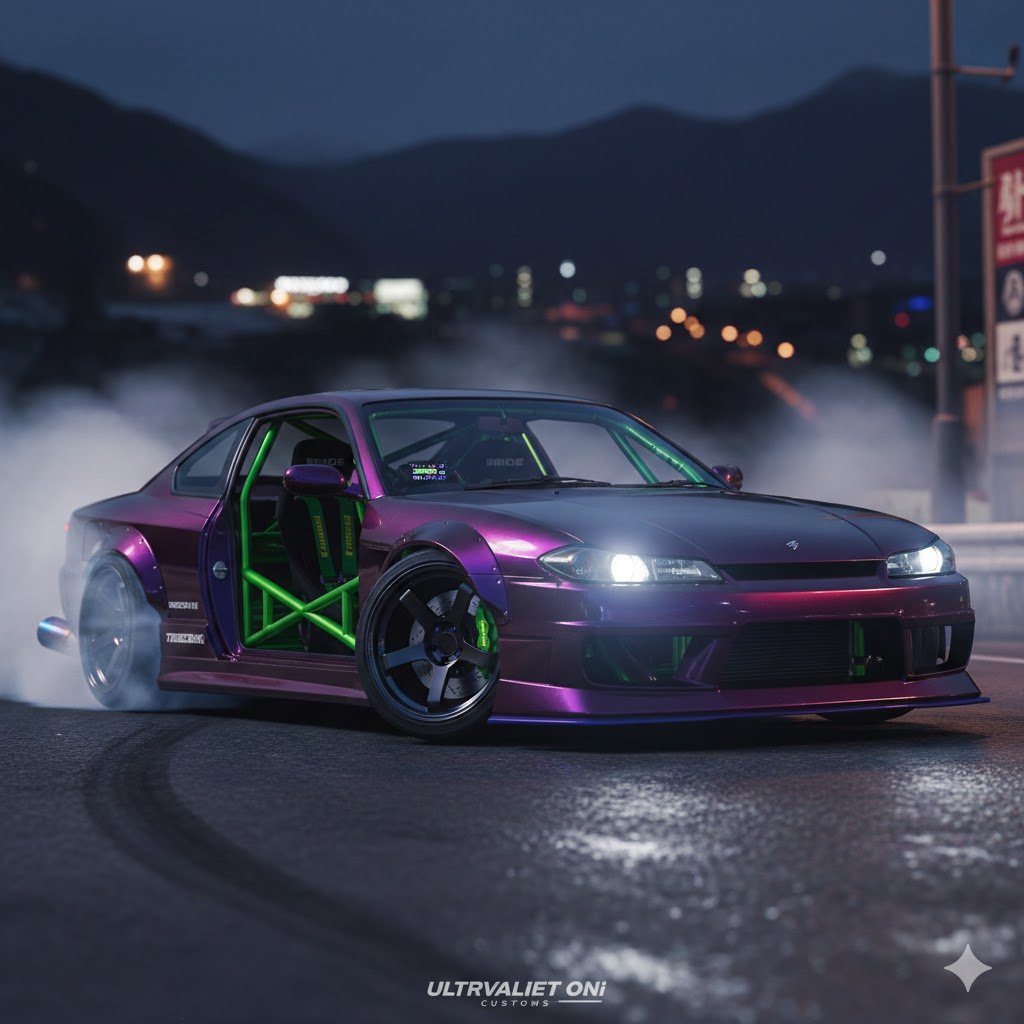
Project Name: The Ultraviolet Oni (Ghost)
Chassis: 1999 Nissan Silvia S15 Spec-R
Concept: A “Street-Legal” D1 Grand Prix contender. Built for maximum angle and high-RPM screaming, wrapped in a color palette that screams JayByrd.
1. The Powerplant: The “Heart of the Dragon”
While many swap in a V8, we’re keeping the Japanese soul but dialing it to eleven.
- Engine: SR20DET (Black Top) bored to 2.2L with a Brian Crower stroker kit.
- Turbo: GReddy T88-34D single turbo conversion.
- The Numbers: $550$ hp at the wheels with a screaming 8,500 RPM redline.
- The Sound: A Tomei Expreme Ti titanium exit—pure, metallic rasp that echoes off the canyon walls.
2. The Drivetrain & Geometry (The “Secret Sauce”)
- Transmission: Nismo 6-speed reinforced close-ratio gearbox.
- Differential: Nismo GT L.S.D. Pro Carbon (2-way) for those locked, predictable slides.
- Steering: Wisefab V2 Front Lock Kit. This gives the car nearly 70° of steering angle, allowing it to go almost completely sideways without spinning out.
- Coilovers: Fortune Auto 510 Series with Swift Springs, valved specifically for “dig” (rear traction) during mid-drift transitions.
3. The Aesthetics: Dream Factory Signature
- Body Kit: Vertex Edge widebody. It’s clean, aggressive, and doesn’t ruin the S15’s natural lines.
- Paint: A deep, multi-stage Midnight Purple III—the kind that shifts to a “Burnt Grape” under the gas station lights.
- The Contrast: * Roll Cage: Finished in a high-gloss Acid Green.
- Brake Calipers: 6-piston Endless calipers in matching Acid Green.
- Wheels: RAYS Volk Racing TE37s in “Magnesium Blue” (or Matte Black to let the green calipers pop).
4. The Cockpit
- Seats: Dual Bride Low Max Kevlar buckets with Green Takata 4-point harnesses.
- Dash: Stack Digital Display replacing the factory needles for that fighter-pilot data readout.
- The Touch: A Nardi Deep Corn steering wheel with purple stitching.
The Dream Factory Customs Philosophy
This build isn’t just about the parts; it’s about the balance. It’s a “Purple and Green” monster that looks like a show car but drives like a weapon. It’s a tribute to the Japanese builders who believe that if a car doesn’t have a soul, it’s just a pile of metal.