One of the most critical, yet often overlooked, components of a successful LS swap is the fuel system. Get it wrong, and you’ll be chasing gremlins, suffering from lean conditions, or worse. Modern LS engines, being fuel-injected, demand consistent, high-pressure fuel delivery, a far cry from the low-pressure carbureted systems many older vehicles were designed for.
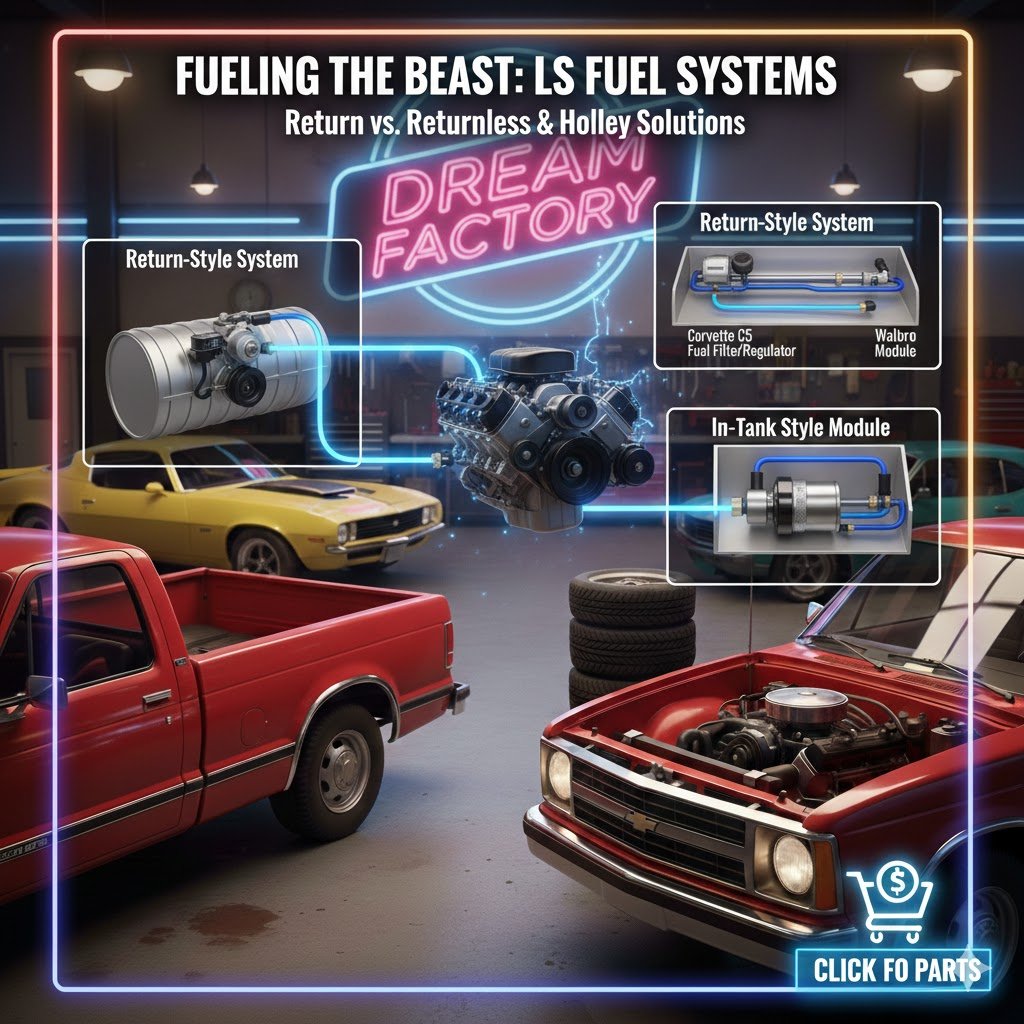
At Dream Factory, we can’t stress enough the importance of getting your fuel system right. Let’s break down the essentials and compare some popular systems, including solutions from Holley.
The LS Fuel System Basics: What You Need
Regardless of the specific components you choose, every LS fuel system needs a few key elements:
- High-Pressure Fuel Pump: Your stock carbureted pump (if you had one) won’t cut it. LS engines typically require 58 PSI (4 bar) of fuel pressure. This means an in-tank or external electric pump capable of delivering that pressure and sufficient flow (GPH – gallons per hour) for your engine’s horsepower.
- Fuel Pressure Regulator (FPR): This maintains the consistent 58 PSI at the fuel rail. You’ll typically choose between a return-style system (where excess fuel is sent back to the tank) or a returnless-style system (where the regulator is near the tank).
- Fuel Filter: A proper filter is essential to protect your injectors. For an EFI system, you’ll need a fine-micron filter (typically 10-micron or less).
- Appropriate Fuel Lines: Original rubber lines are often too small and not rated for the high pressure and corrosive nature of modern fuels (especially E85). You’ll need properly sized AN fittings and PTFE/braided lines or high-pressure EFI-rated rubber hose.
- Fuel Tank/Sender: Depending on your setup, you might adapt your stock tank, install a new baffled EFI tank, or use a fuel cell.
Common LS Fuel System Setups & Comparisons
Let’s look at the most popular ways to set up an LS fuel system, with a focus on what each entails.
1. The “Corvette C5 Filter/Regulator” Method (Returnless)

This is a very popular and cost-effective solution for many LS swaps, especially those with moderate horsepower goals (up to 500-600hp).
- How it Works: A single, high-pressure fuel line runs from your fuel pump to the Corvette C5 filter/regulator (often mounted near the tank). This unit has a built-in 58 PSI regulator, a filter, and a return port that sends excess fuel back to the tank directly from the filter. A single, regulated line then runs from the C5 filter to your LS fuel rail.
- Pros: Simple plumbing (one line to the engine), clean engine bay, very affordable.
- Cons: Not ideal for high-horsepower forced induction setups (pressure drop can occur). Limited adjustability. The return line from the filter needs to be adequate.
- Ideal For: Stock to moderately modified naturally aspirated LS engines.
2. External Aftermarket Regulator (Return-Style)
This is a more traditional and adjustable return-style setup.
- How it Works: The fuel pump sends full pressure to the engine’s fuel rail. A dedicated aftermarket fuel pressure regulator is mounted on the fuel rail (or close to it) with a vacuum reference port. Excess fuel is then returned from the regulator back to the tank via a separate return line.
- Pros: Highly adjustable fuel pressure (crucial for tuning, especially with forced induction), excellent pressure stability, allows for larger fuel lines for high HP.
- Cons: More complex plumbing (supply and return lines running the full length of the vehicle). Can be more expensive.
- Ideal For: High-horsepower builds, forced induction, custom tuning.
3. In-Tank Fuel Pump Module (Returnless or Return-Style)
Many modern vehicles use an all-in-one in-tank module that combines the pump, sender, and often the regulator.
- How it Works: A complete module drops into your fuel tank. Depending on the module, it might be a returnless design (like many OEM modules) or a return-style with a separate regulator.
- Pros: Quiet operation, keeps the pump cool, integrated solutions save space and complexity. Often comes with baffling to prevent fuel starvation on corners.
- Cons: Requires modifying or replacing your fuel tank. Specific modules might be needed for your tank’s depth/shape.
- Ideal For: Clean, OEM-style installations. Great for newer tanks or custom tanks designed for these modules.
Holley LS Fuel System Solutions: A Closer Look
Holley is a dominant player in the aftermarket, offering comprehensive solutions for LS swaps. They cater to a wide range of needs, from simple swaps to extreme performance.
Holley Sniper EFI Fuel Systems (External & In-Tank)
- Overview: Holley’s Sniper line extends beyond just throttle bodies to include complete fuel systems. They offer everything from in-tank pump modules (e.g., for specific tank applications) to external pump kits and complete fuel lines.
- Key Features: Designed for easy integration with their Sniper EFI systems, but compatible with any LS ECU. Often include all fittings, lines, and pumps.
- Why Choose: If you’re using a Holley EFI system (Terminator X, Sniper, etc.), their fuel systems are designed to integrate seamlessly. They also offer excellent technical support.
Holley Dominator / HP EFI Fuel System Components
- Overview: For serious builds, Holley offers individual high-performance fuel system components: fuel pumps (in-tank and external, single or dual), adjustable fuel pressure regulators, fuel rails, and specific line kits.
- Key Features: Built for extreme flow and pressure stability. Compatible with E85. Designed for modularity, allowing you to build a system perfectly matched to your engine’s demands.
- Why Choose: When you’re pushing boundaries (1000+ HP), need specific E85 compatibility, or want ultimate control and adjustability, Holley’s top-tier components are a go-to.
Dream Factory Recommended Parts (Amazon Search Terms)
Remember to verify fitment and flow rates for your specific LS engine and horsepower goals.
- Corvette C5 Fuel Filter Regulator: Search for “ACDelco GF822“ or “Corvette C5 fuel filter regulator“.
- Walbro 255/450 Fuel Pump (In-Tank): “Walbro 255 lph fuel pump“ or “Walbro 450 lph fuel pump“.
- Holley EFI Fuel Pump Module: Search for “Holley fuel tank module” (specify tank type if possible, e.g., “Holley F-body fuel module”).
- Holley EFI Fuel Pressure Regulator: Search for “Holley EFI fuel pressure regulator“ (look for billet, adjustable regulators).
- AN Fuel Line Kit: Search for “AN-6 PTFE fuel line kit“ or “AN-8 PTFE fuel line kit“ (choose -6 AN for most NA engines, -8 AN for higher HP).
- LS Fuel Rail Kit: “LS fuel rail kit“ (check for specific engine generation, e.g., LS1, LS3).
Final Thoughts from the Dream Factory
The fuel system is the heart of your LS swap’s reliability. Don’t skimp here! Plan for your current and future power goals, choose components that match, and ensure your lines and connections are secure and leak-free. A properly designed fuel system ensures your LS runs strong, safe, and efficient, whether you’re cruising the strip in Tennessee or tearing up the track.