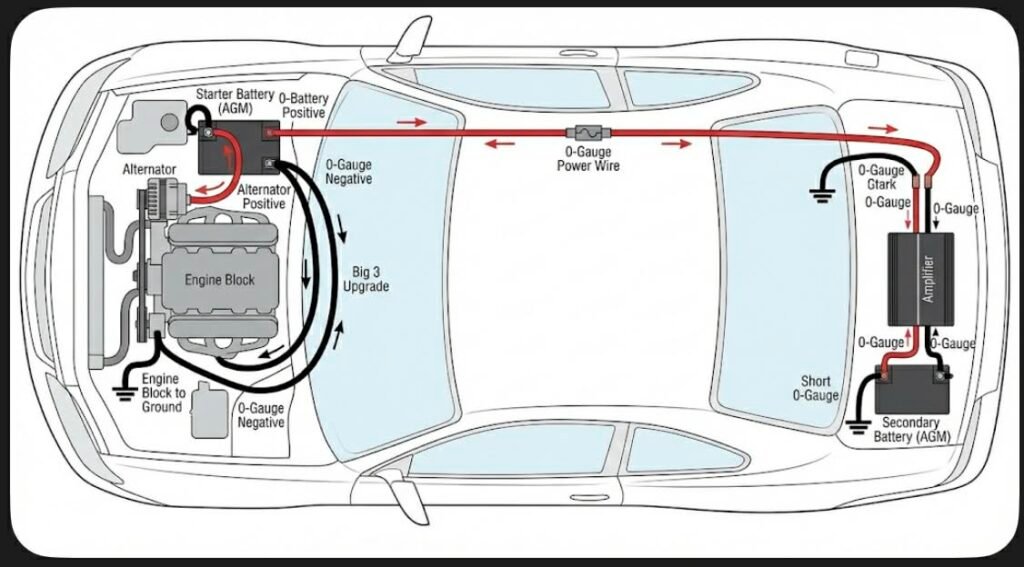
Your battery does not power your system while the car is running—your alternator does. The battery is just a buffer. If your alternator can’t keep up with the music, your voltage drops. When voltage drops, heat rises. When heat rises, amplifiers blow up.
Most factory alternators are rated for 100 to 130 amps. The car itself needs about 60 of those amps just to run the A/C, headlights, fuel pump, and computer. That leaves you with maybe 40 amps for your music. That is nothing.
The Golden Rule: When do you need to upgrade?
For beginners, here is the line in the sand:
• Under 1,000 Watts RMS: You are usually safe with the Stock Alternator + Big 3 Upgrade + Good AGM Battery.
• 1,000 to 2,000 Watts RMS: You are entering the danger zone. You will see light dimming. You definitely need a High Output Alternator (200-250 Amps).
• Over 2,000 Watts RMS: Mandatory upgrade. If you run this on a stock alternator, you will burn it out in a month. You need a 300+ Amp Alternator and possibly Lithium batteries.
The Napkin Math: How big of an alt do I need?
Stop guessing. Do the math. It’s simple: Amps = Watts divided by Voltage.
1. Find your Total RMS Power: (Example: You have a 2,000 Watt RMS amplifier).
2. Divide by 13.8 Volts: (2,000 / 13.8 = 145 Amps).
• Note: This is just what the AMP needs.
3. Add the Car’s Demand: Add roughly 50-60 Amps for the vehicle itself.
• 145 Amps (Amp) + 60 Amps (Car) = 205 Amps Total.
The Verdict: In this example, a stock 130-amp alternator will fail. You need at least a 240-Amp High Output Alternator to stay safe and keep your voltage steady.
The “Ebay Special” Warning
Listen closely: Do not buy the $150 “High Output” alternator from eBay or Amazon.
They lie about their ratings. A real high-output alternator requires expensive copper windings and billet cases. Cheap ones usually just put a smaller pulley on a stock unit to spin it faster, which creates heat and fails at idle.
• Stick to the Kings: Brands like Mechman, Singer, JS Alternators, and Brand X. Yes, they cost $400-$600. Yes, they are worth every penny when your amp doesn’t blow up.
Summary for the Young Gen
If you want to run big power, you have to pay the “power tax.” There is no cheat code.
1. Add up your fuse ratings on your amps.
2. If the total fuse rating is higher than your alternator’s amp rating, you are running on borrowed time.
3. Upgrade the alternator before you upgrade the subs.