In Japan, space is the ultimate luxury. This geographic reality gave birth to one of the most unique automotive segments in the world: the Kei Jidousha (light automobile). While the rest of the world was building bigger, heavier, and more thirsty machines, Japanese engineers were forced to play a high-stakes game of “Tetris” with engine displacement and chassis dimensions.
The result? Some of the most creative, high-revving, and technically impressive builds ever to hit the asphalt.
1. The Rules of the Game
To qualify as a Kei car, the constraints are brutal:
- Engine Displacement: No more than 660 cc (roughly the size of a large motorcycle engine).
- Power: Capped at 64 hp.
- Size: Must not exceed 3.4 meters in length.
To an ordinary builder, these rules are a cage. To a Japanese builder, they are a challenge to prove that power-to-weight ratio and mechanical efficiency are more important than raw muscle.
2. The “ABC” Trinity of the 90s
During the Japanese bubble economy, engineers went wild, creating the “ABC” cars—the holy trinity of the Kei world:
- A – Autozam AZ-1: Built by Mazda, this mid-engine miniature supercar featured gull-wing doors and a tubular frame. It looks like a baby Ferrari and handles like a go-kart on steroids.
- B – Honda Beat: The final project approved by Soichiro Honda himself. It used a naturally aspirated engine with Triple Throttle Bodies (MTREC system) that screamed to a 9,000 RPM redline.
- C – Suzuki Cappuccino: A front-engine, rear-wheel-drive roadster with a 50:50 weight distribution. It’s essentially a Mazda Miata that shrunk in the wash, but with a turbocharged heart that tuners love to crank up.
3. The “Mini-Monster” Build Culture
Building a Kei car is about “The Art of Less.” Because the engines are small, every gram of weight matters.
- The Power Paradox: While the factory limit is 64 hp, the aftermarket doesn’t follow the law. Builders often swap in larger turbos, intercoolers, and standalone ECUs to push these 660 cc engines to 120 hp or more. In a car that weighs less than 1,600 lbs, that’s a terrifying amount of fun.
- The Miniature GTs: A massive trend in Japan right now is “scaling down” legendary icons. You’ll find Suzuki Jimnys modified to look like miniature Mercedes G-Wagons (the “Little G”) or Daihatsu Copen roadsters built to look like tiny Nissan GT-Rs.
4. The Shokunin Spirit in Small Scale
The Kei car culture represents the Shokunin (craftsman) spirit at its most focused. It’s about taking a limited platform and refining it until it’s perfect. It’s the automotive version of a Bonsai tree—small, meticulously shaped, and deeply respected.
The Dream Factory “Micro-Monster” Concept
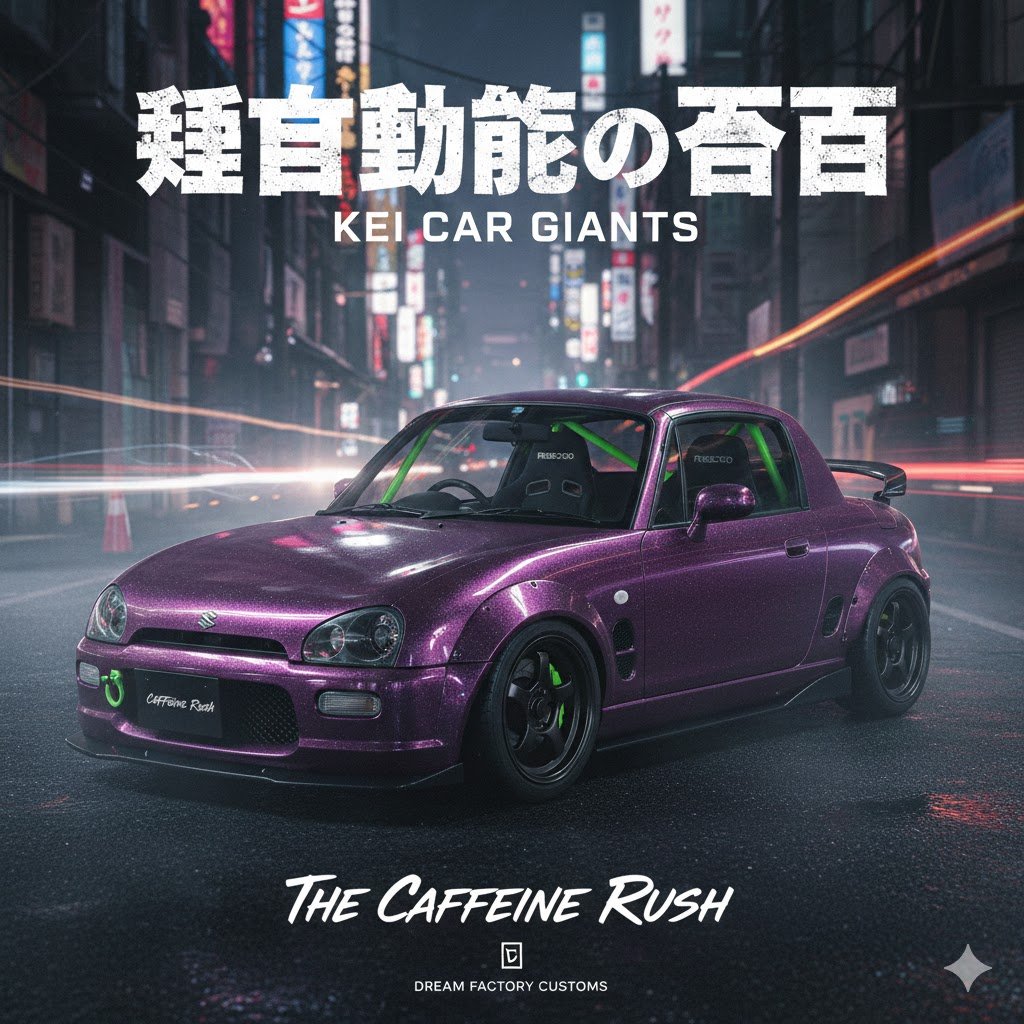
If Dream Factory Customs were to tackle a Kei build, imagine a Suzuki Cappuccino in a deep, metallic Grape Purple.
- The Pop: Exposed Acid Green intercooler piping peeking through the front bumper.
- The Stance: Wide-fender flares over deep-dish 13-inch wheels.
- The Soul: A full turbo-back exhaust that makes this tiny 3-cylinder sound like a miniature fighter jet.
Would you like me to generate a spec sheet for this “Micro-Monster” Cappuccino, or should we go straight to the poster design?
Project Name: The Caffeine Rush
Chassis: 1993 Suzuki Cappuccino (EA11R)
Concept: The “Bonsai Predator”—a tiny, turbocharged street fighter that proves you don’t need a V8 to make a statement.
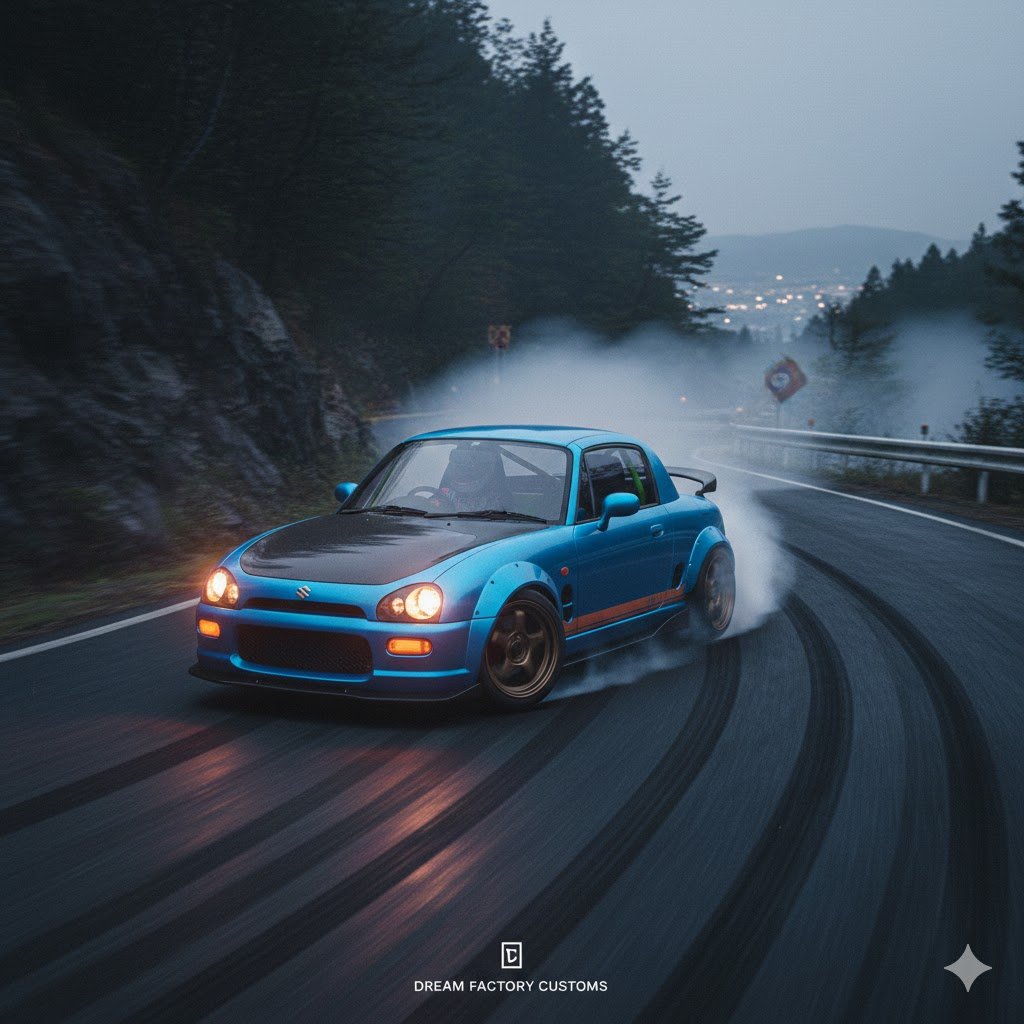
1. The Powerplant: Small Engine, Big Attitude
- Engine: F6A 3-cylinder turbocharged, $657$ cc.
- Performance Upgrades: * Monster Sport K200 turbocharger kit.
- Upgraded fuel injectors and a high-flow fuel pump.
- Custom Dream Factory side-exit exhaust (flames guaranteed).
- The Numbers: Pushing 125 hp (nearly double the factory limit) in a car that weighs only $1,500$ lbs. That’s a power-to-weight ratio that rivals most modern sports cars.
2. The Stance & Grip
- Suspension: Ohlins DFV (Dual Flow Valve) coilovers, dialed in for tight, responsive city carving and occasional gymkhana.
- Wheels: 14-inch RS Watanabe Eight Spoke wheels in a custom “Satin Black” finish.
- Tires: Yokohama Advan A052 tires—maximum stick for a car this light.
3. The Aesthetics: The JayByrd Signature
- Body: Toyoshima Craft carbon fiber hood and trunk lid to shed even more weight.
- Paint: A deep, metallic Grape Purple with a heavy flake that glows under streetlights.
- The Accent: Acid Green accents on the brake calipers, the front tow hook, and the “Cappuccino” badging on the rear.
- The Aero: A ducktail rear spoiler and a subtle front lip to keep the “Bonsai” looking aggressive without losing its classic lines.
4. The Cockpit: “The Greenhouse”
- Seats: Low-profile Recaro Pole Position buckets with Acid Green stitching.
- Roll Bar: A custom 4-point half-cage finished in Acid Green to tie the exterior theme into the cabin.
- The Touch: A 330mm Nardi Personal steering wheel and a custom Dream Factory shift knob.