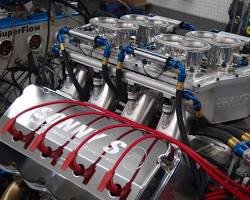
When engine building legend Sonny Leonard unveiled the 1,005 cubic inch (16.5L) V8 at the 2011 PRI show, it wasn’t just a “big-block”—it was a seismic shift in displacement that earned it the nickname “The Godfather.” Sonny Leonard, the king of the “Mountain Motor,” didn’t just bore out an existing design; he engineered a billet-aluminum masterpiece that redefined the limits of naturally aspirated power.
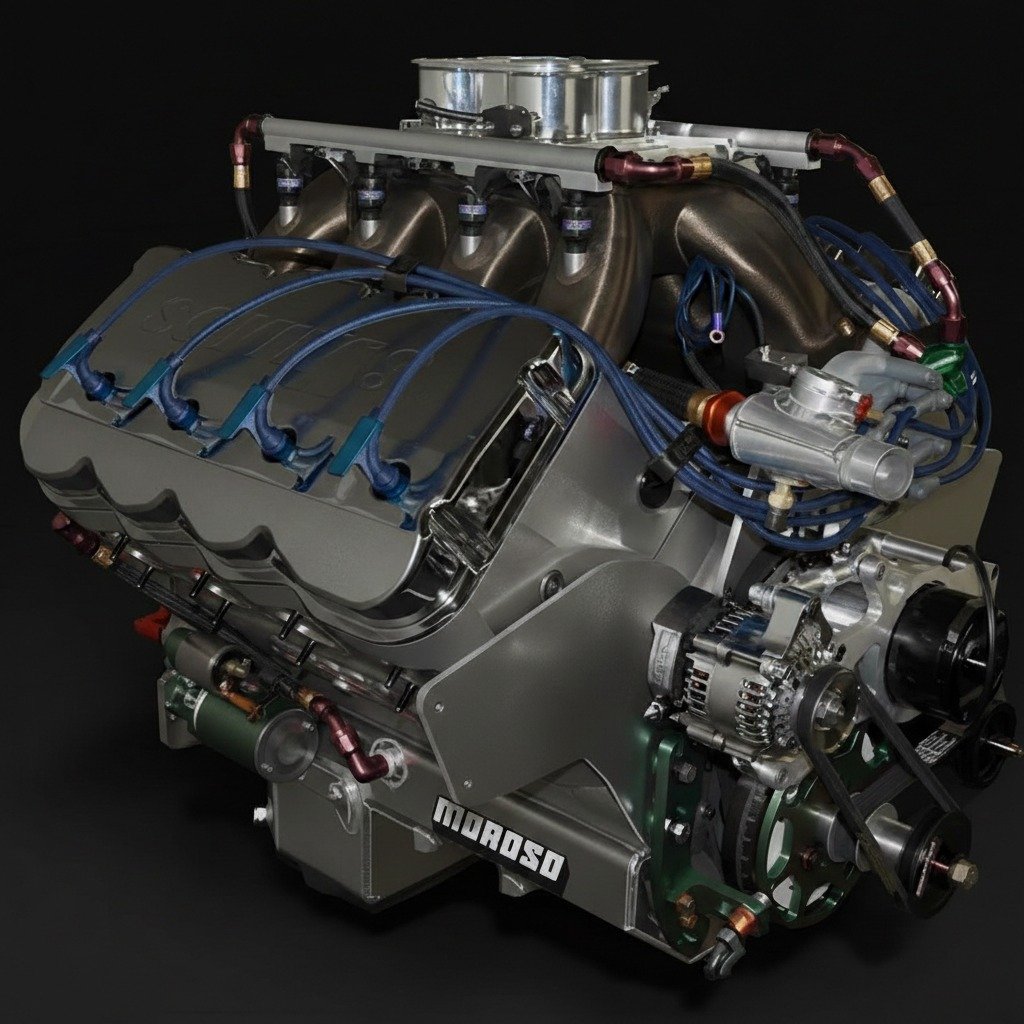
The Stats: Numbers That Don’t Seem Real
To put this into perspective, a standard 454 big-block Chevy is roughly 7.4 liters. This “Monster” is 16.5 liters.
| Feature | Specification |
| Displacement | 1,005.8 Cubic Inches (16.5 Liters) |
| Horsepower | 2,150+ HP @ 8,000 RPM (Naturally Aspirated) |
| Torque | 1,500+ lb-ft @ 6,200 RPM |
| Bore x Stroke | 5.220″ x 5.875″ |
| Compression | 16.0:1 (Race Trim) |
| Fuel | 112 Octane Racing Fuel |
| Price (at launch) | Approx. $140,000 |
Engineering “The Godfather”
Building an engine of this scale required moving away from every traditional constraint of the Chevrolet Big Block architecture.
- The Billet Block: The block is a custom CNC-machined billet aluminum piece with 5.4-inch bore centers. For comparison, a standard Chevy 350 has 4.4-inch centers. This extra spacing was necessary to keep the cylinder walls from becoming paper-thin.
- The “Hemispherical” Heads: Sonny used his “Next Generation” fully CNC-ported hemispherical cylinder heads. The intake valves are a massive 2.9 inches—larger than the exhaust piping on many performance cars.+1
- The Valvetrain: Because the valves are so large, they are made of titanium to prevent them from becoming heavy projectiles at high RPM. The pushrods are 5/8″ thick (standard is 3/8″) to handle the incredible pressures.+1
- Fuel Delivery: It uses a massive sheet metal intake manifold equipped with four Accufab throttle bodies and a sophisticated EFI system with 16 injectors (two per cylinder) to keep the beast fed.
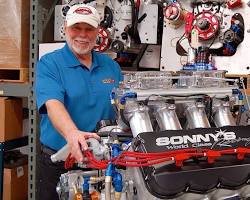
Why 1,005 Cubic Inches?
Before this engine, the “ceiling” for mountain motors was typically around 800-900 cubic inches. Sonny built this specifically for a customer who wanted to break the 1,000-inch barrier.
While it was designed for Pro Mod and extreme drag racing, one version was actually fitted into a 1968 Corvette in Denmark for street use. Imagine pulling up to a stoplight next to a 16.5L engine that idles like “controlled thunder.”
“This is the Big Daddy of all engines… who else could produce such an amazing engine but Sonny himself?” — Sonny’s Racing Engines
The 1,005 cubic inch “Monster” found its most famous home in a custom-built 1968 Corvette in Denmark. This wasn’t a stripped-out dragster, but a functional street car—albeit one with more displacement than most semi-trucks.
The 1,005ci “Street” Corvette
To make a 2,150-horsepower Pro Mod engine live on the street, several major engineering hurdles had to be cleared:
- Cooling: A custom high-capacity cooling system was required to keep 16.5 liters of displacement from overheating at a stoplight.
- The Hood (or Lack Thereof): The engine is so tall that the intake manifold and throttle bodies sit completely above the hood line, requiring a massive custom scoop that barely clears the driver’s field of vision.
- Drivability: While it can run on pump gas for cruising, the 16.0:1 compression ratio version requires high-octane racing fuel to reach its full potential.
- The Sound: Even at a 900 RPM idle, the displacement produces a low-frequency vibration that can be felt in the ground from a block away.
Comparison: 1,005ci N/A vs. Forced Induction Pro Mod
In the world of Pro Mod racing, the Sonny Leonard 1,005ci engine represents the pinnacle of “No Replacement for Displacement.” Here is how it stacks up against modern boosted setups:
| Feature | 1,005ci “Godfather” (N/A) | Twin-Turbo / Blower Pro Mod |
| Power Delivery | Instant, linear torque from 0 RPM. | “Laggy” until boost builds, then violent. |
| Complexity | High (massive custom parts). | Very High (plumbing, intercoolers, wastegates). |
| Maintenance | Frequent valvetrain checks. | Extreme heat management and head gasket risk. |
| Reliability | Generally higher for the power level. | High stress on internal components due to boost. |
While a 500ci twin-turbo engine can technically make more peak horsepower (3,000+ HP), the 1,005ci naturally aspirated engine is prized for its reliability and the sheer “shock and awe” of its physical size.