If you hang around a garage long enough, the argument is inevitable. It’s the Ford vs. Chevy of the engine world, but it happens right here under the bowtie banner.
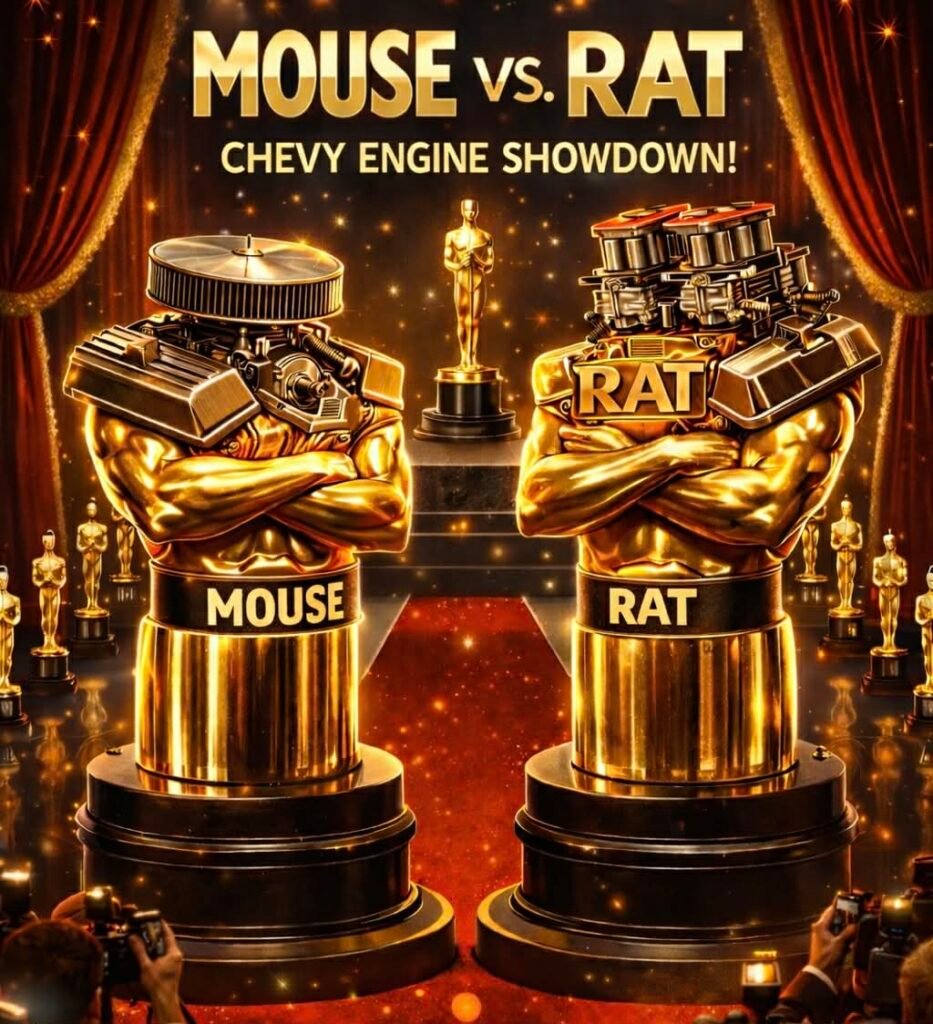
The Small Block Chevy (The Mouse) vs. The Big Block Chevy (The Rat).
At Dream Factory Customs, we believe the right engine isn’t just about horsepower numbers—it’s about the mission. Are you building a canyon carver, a daily cruiser, or a quarter-mile monster?
Here is the breakdown to help you decide.
THE SMALL BLOCK (SBC)
The Lightweight Champion
The Small Block Chevy (SBC) changed the world in 1955. It is compact, lightweight, and arguably the most supported engine in history. From the 283 to the legendary 350 and the 400, “The Mouse” is famous for punching above its weight class.
PROS:
• Weight: An iron small block is significantly lighter than a big block (usually by 150-200 lbs). This means better handling, better braking, and a better balanced car.
• Cost: You can build a 400hp Small Block for a fraction of the cost of a Big Block. Parts are available at every auto parts store in America.
• Fitment: It fits in everything. No hammering the firewall or fighting for header clearance.
• Efficiency: Generally better MPG (though let’s be honest, we don’t build these for fuel economy).
CONS:
• Torque: It has to rev higher to make power. It doesn’t have that “freight train” pull right off idle that a Big Block has.
• Visuals: It looks physically smaller in a large engine bay (like a Chevelle or Impala).
BEST FOR:
Daily drivers, autocross/handling cars, tight engine bays (Novas, S-10s), and budget-friendly builds.
THE BIG BLOCK (BBC)
The Heavyweight King
The Big Block (396, 427, 454) is exactly what it sounds like. Massive physical size, massive displacement, and massive attitude. When you pop the hood, there is no mistaking “The Rat.”
PROS:
• Torque: The torque is immediate and violent. You don’t need to rev it to 6,000 RPM to feel it; you feel it the second you touch the gas.
• Durability: Big blocks have massive components. They can handle huge amounts of abuse without breaking a sweat.
• The “Wow” Factor: Nothing looks (or sounds) like a Big Block stuffing the engine bay. It commands respect at every car show.
CONS:
• Weight: It’s heavy. That extra weight on the nose affects how the car turns and stops.
• Cost: Everything is more expensive. Pistons, heads, machine work—the “Big Block Tax” is real.
• The Squeeze: Installing one in a smaller car often means tight header clearance, cooling issues, and busting knuckles.
BEST FOR:
Drag racing, heavy cars (Impala, Caprice), trucks, and show cars where you want maximum visual impact.
THE VERDICT
If you want a car you can drive to work on Friday and tear up backroads on Saturday, go Small Block. It’s the versatile hero.
If you want to shake the ground at a stoplight and feel like you’re being shot out of a cannon every time the light turns green, go Big Block.
At Dream Factory Customs, we build what moves you. What’s going in your next project?