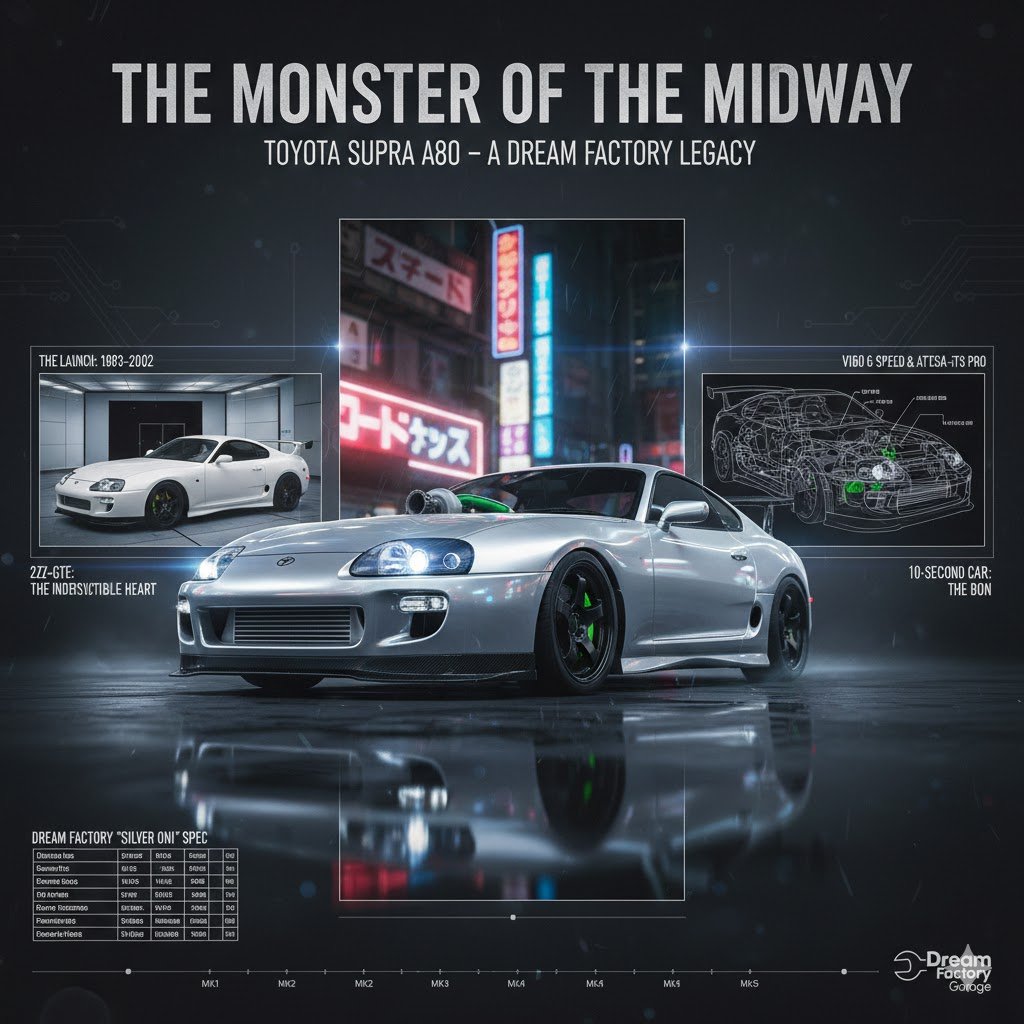
If the R34 is the “Hero” of the digital age, the Toyota Supra MK4 (A80) is the undisputed “Monster” of the asphalt. Here at Dream Factory Garage, we respect the Supra because it represents a time when Toyota stopped playing it safe and decided to build a supercar-killer that was virtually indestructible.
For the new generation of builders, this is the blueprint of the legend.
1. The Launch (1993–2002): Overbuilt by Design
When the MK4 Supra debuted in 1993, it was a radical departure from the boxy MK3. Chief engineer Isao Tsuzuki had a “Less is More” philosophy for weight but a “More is Better” philosophy for strength.
- Lightweight Precision: Toyota used aluminum for the hood, targa top (if optioned), and even the suspension arms to keep the weight down to about 3,400 lbs.
- The “Fighter Jet” Cockpit: Open the door, and the entire dashboard wraps around the driver. Every gauge and switch is angled toward you. It wasn’t designed for a passenger; it was designed for a pilot.
2. The Heart: The 2JZ-GTE
You can’t talk about the Supra without talking about the 2JZ. This 3.0L Inline-6 is the primary reason this car is called “The Monster.”
- The Block: Unlike many modern engines, the 2JZ uses a cast-iron block. It’s heavy, but it can handle internal pressures that would blow an aluminum block to pieces.
- Sequential Twin Turbos: From the factory, it used a complex two-turbo system. One kicked in at 2,500 RPM for low-end grunt, and the second took over at 4,500 RPM for the top-end scream.
- The “1,000 HP” Myth: It’s not a myth. The 2JZ is so over-engineered that the stock bottom end (crank and rods) can often handle 700–800 hp before you even have to open the engine.
3. The “Gentleman’s Agreement” & Real Power
Like the Skyline, the Supra was caught in the Japanese “Gentleman’s Agreement.”
- JDM Specs: Officially rated at 276 hp.
- Export Specs (US/Europe): Came with bigger fuel injectors and steel-wheeled turbos (instead of ceramic), officially rated at 320 hp.
- The Benchmark: In 1993, a stock Supra Turbo could do 0–60 mph in 4.6 seconds. That was faster than the contemporary Ferraris and Corvettes of the time.
4. The Legend of the V160
To handle the “Monster’s” torque, Toyota partnered with Getrag to create the V160 6-speed manual transmission.
- The Bulletproof Box: Much like the engine, this transmission is legendary for its strength. It is widely considered one of the toughest manual gearboxes ever put in a production car, often holding 1,200+ hp without failing.
5. Pop Culture: The Ten-Second Car
The Supra was a respected enthusiast car in the 90s, but the 2001 film The Fast and the Furious turned it into a global icon. When Brian O’Conner brought a “10-second car” to Dominic Toretto’s garage, a whole new generation realized that a Japanese import could take down a classic American Muscle car.
The Dream Factory “Silver Oni” Supra Concept
If we were rolling an A80 out of the Dream Factory bays today:
- The Look: Quicksilver Metallic paint with a high-gloss finish, paired with our signature Acid Green accents on the intercooler piping and brake calipers.
- The Stance: 19-inch TRD-style 5-spoke wheels in a deep-dish matte black.
- The Power: A single-turbo conversion (Garrett G45) pushing a reliable 850 hp on E85 fuel.
- The Wing: The iconic “hoop” wing is a must, but in exposed carbon fiber.