At Dream Factory Garage, we believe you shouldn’t need a mechanic’s degree to know if your ride is in trouble. Your transmission is the “brain” that tells your wheels how to use the engine’s power. When it’s unhappy, it sends very specific signals through sound, feel, and color.
Here is the ultimate cheat sheet for anyone who just wants to keep their car on the road and out of the scrap yard.
1. The Color Palette: Reading the Dipstick
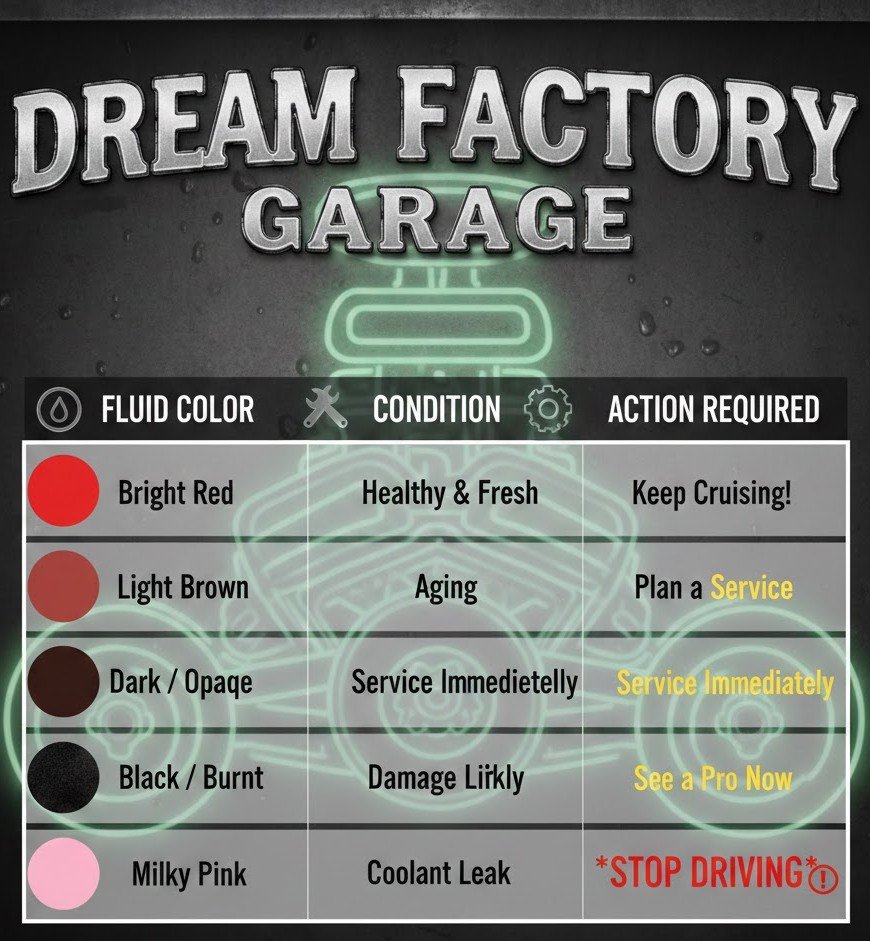
Most automatic transmission fluid (ATF) is dyed bright red so you can tell it apart from motor oil or antifreeze. Use this guide to check your fluid’s health:
- Bright Pink/Red (New): You’re golden. The fluid is fresh and lubricating perfectly.
- Light Brown/Brick Red (Normal): This is standard wear. It’s still doing its job, but you should keep an eye on it.
- Dark Brown/Opaque (Service Soon): The fluid is oxidizing (breaking down). It’s losing its ability to protect your gears.
- Black or “Burnt Toast” Smell (Danger): This is the “Code Red.” Black fluid usually means internal parts are actually burning. If it smells like scorched bread, don’t just change the fluid—get a professional inspection immediately.
- Milky Pink (The Strawberry Milkshake): This is bad news. It means engine coolant has leaked into your transmission. This will destroy a transmission in miles if not caught.
2. The Sound Check: What’s That Noise?
Transmissions are designed to be quiet. If you start hearing these, your car is talking to you:
- The Whine: A high-pitched whine that gets louder as you accelerate often means your fluid is low or the pump is struggling.
- The Clunk: If it “clunks” when you shift from Park to Drive, you might have worn out mounts or internal gear issues.
- The Grinding: Usually felt in manual transmissions, this means your synchronizers or clutch are wearing out. In an automatic, grinding is a sign of major metal-on-metal damage.
- The Hum or Buzz: Often heard while idling, this can point to a failing torque converter or internal bearings.
3. The “Feeling”: How Does It Shift?
You know how your car usually feels. If the “vibe” changes, pay attention:
- Slipping: You press the gas, the engine revs up (RPMs go high), but the car doesn’t speed up right away. It feels like the “gears” are made of butter.
- The Shudder: If the car shakes or vibrates specifically when shifting gears, your fluid might be contaminated or your torque converter is acting up.
- Delayed Engagement: You put it in Drive, wait two seconds, and then it slams into gear. This is a classic sign of low fluid pressure.
- Rough Shifts: Instead of a smooth transition, the car “jerks” or “kicks” you in the seat when it changes gears.
4. Service Time: When to Act?
Don’t wait for the “Check Engine” light—by then, the damage is often done.
- Standard Rule: Every 30,000 to 60,000 miles for most vehicles.
- Severe Duty: If you’re towing, hauling, or stuck in Knoxville stop-and-go traffic every day, consider a service every 30,000 miles.
- The “No Dipstick” Problem: Many modern cars have “sealed” transmissions with no dipstick. For these, you must have a shop check the levels during your regular oil changes.
Pro Tip: A “Fluid Change” only replaces about 30-50% of the fluid. A “Fluid Flush” uses a machine to replace nearly 100%. If your fluid is already black and burnt, a flush can sometimes do more harm than good by dislodging gunk—talk to us first!