If you are building your first Small Block Chevy, you are standing at a crossroads. Down one path is the legendary 350—the engine that built the hot rod world. Down the other path is the 383 Stroker—the “big brother” that promises to shred tires and hurt feelings.
For the new generation of builders, the internet makes this confusing. Is a 383 harder to build? Is a 350 “too slow”? Here is the no-nonsense breakdown of the difference, the cost, and which one belongs in your engine bay.
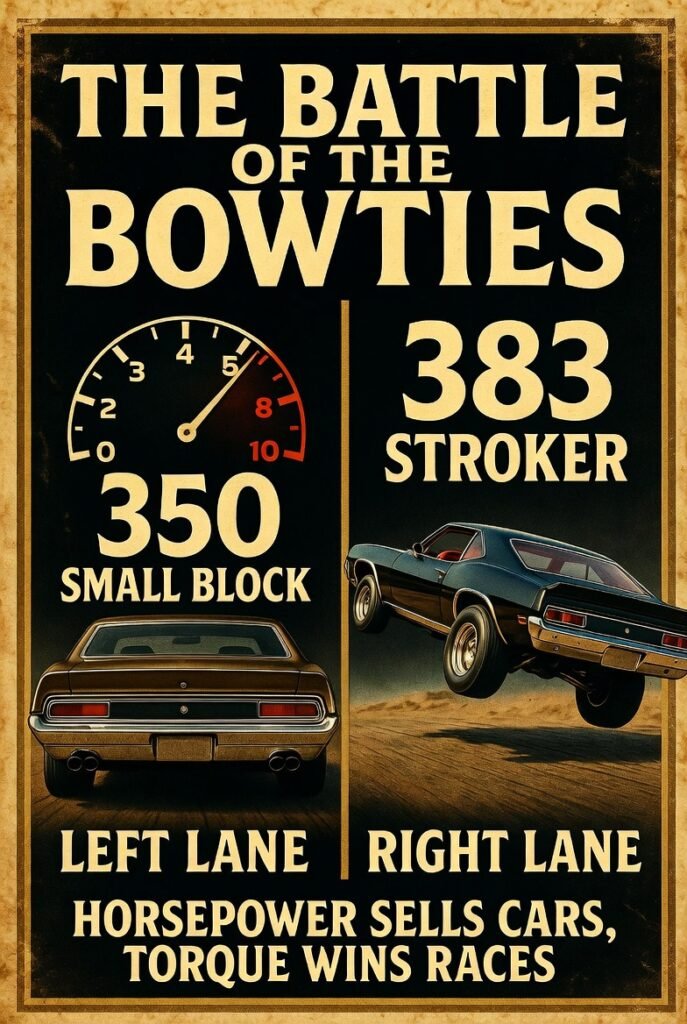
The Contender: The 350 Small Block
The “Old Faithful”
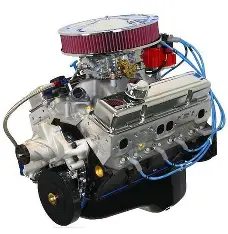
The 350 is the most common V8 on the planet for a reason. It’s cheap, parts are available at every gas station in America, and it loves to rev.
- The Vibe: High-RPM screamer. A properly built 350 is happy to spin to 6,500+ RPM all day long.
- The Pros:
- Budget King: You can build a 350 for dirt cheap. You don’t need special pistons or cranks; stock parts work fine for 350-400 horsepower.
- Simple Assembly: No grinding, no checking weird clearances. It’s “plug and play” engine building.
- The Cons: It lacks low-end grunt compared to the stroker. In a heavy car (like a G-Body or truck), a 350 needs deep rear gears (3.73+) to feel really fast off the line.
The Heavyweight: The 383 Stroker
The “Torque Monster”
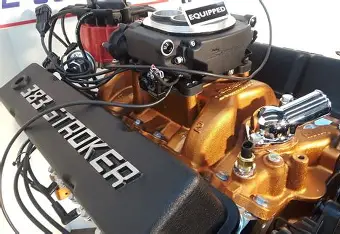
A 383 isn’t a different block—it’s a 350 block with a longer arm. By putting a crankshaft from a 400 cubic inch engine (or a custom aftermarket crank) into a 350 block, you increase the “stroke” (how far the piston travels up and down).
- The Math: Longer Stroke = More Leverage = Massive Torque.
- The Vibe: Tire melter. A 383 makes huge power instantly, right off idle. You don’t need to rev it to the moon to feel the power; it pulls like a freight train from stoplight to stoplight.
- The Pros:
- Street King: Torque is what you feel in the “seat of your pants” on the street. A 383 feels significantly faster than a 350 in normal driving.
- Moves Heavy Metal: If you have a Cutlass, Monte Carlo, or C10 truck, the extra torque helps move that heavy weight effortlessly.
- The Cons:
- “Clearancing” Required: Because the crankshaft throw is wider, the connecting rods might hit the inside of the engine block. You (or your machine shop) have to grind away metal inside the block to make room. It’s extra work and extra cost.
- Price: You need a new crank and specific pistons. It usually costs about $500–$800 more to build than a standard 350.
The Dream Factory Verdict
Build the 350 IF:
- You are on a super tight budget (under $2,500 total).
- This is your very first engine build and you want to keep it simple.
- You have a lightweight car (like an S10 or a T-Bucket).
Build the 383 Stroker IF:
- You have a little extra cash and want the most “smile per gallon.”
- You drive a heavy car (G-Body, Impala, Truck).
- You want to do burnouts without even trying.
The Bottom Line: Horsepower sells cars, but torque wins races on the street. If you can afford the stroker kit, build the 383. You will never regret the extra torque.
Steel & Soul – Dream Factory Garage