
Walk into any speed shop or car meet, and you’ll hear it: “Yeah, man, I’m running a Double Pumper.”
It sounds cool. It sounds fast. But in the world of carburetion, “cool” doesn’t always mean “fast.” In fact, picking the wrong style is the easiest way to turn your snappy street machine into a bogging, gas-guzzling mess.
At Dream Factory Garage, we build for the street and the soul. Here is the truth about the two heavyweights of fuel delivery, and how to decide which one belongs on your intake manifold.
The Contender: Vacuum Secondaries
The Street Fighter https://amzn.to/4kGCXbB
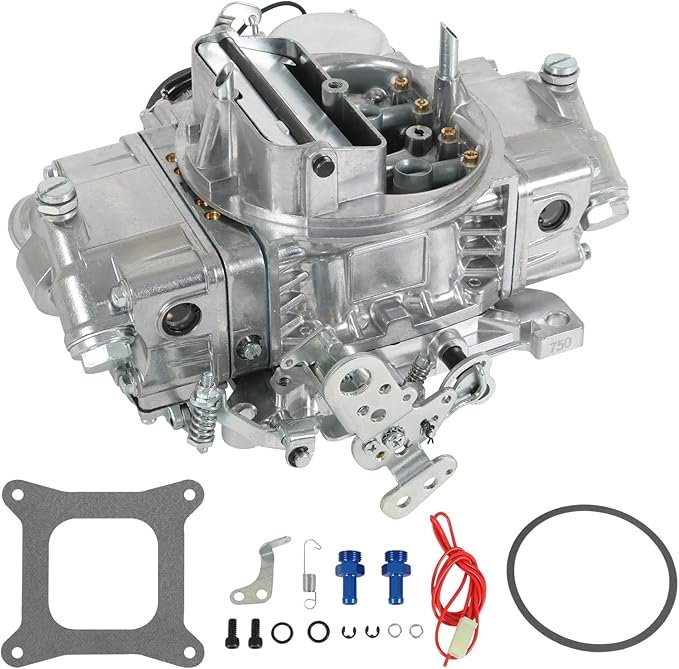
This is the most misunderstood carb in the game. On a vacuum secondary carburetor, the rear barrels (the “secondaries”) are not connected directly to your gas pedal. Instead, they are operated by a vacuum diaphragm that senses engine load.
- How it works: When you mash the gas, the front barrels open. As the engine RPMs climb and airflow velocity increases, a vacuum signal pulls the rear barrels open gradually.
- The Magic: Because the carb waits until the engine needs the air to give it the air, you get a smooth, seamless rush of power. There is no “bog” or hesitation.
- The Myth: “Vacuum secondaries are slow.” False. On a street car, they are often faster because they prevent the engine from stumbling off the line.
Best For:
- Automatic transmissions (especially with stock torque converters).
- Heavier cars (like a Monte Carlo, Cutlass, or Chevelle).
- Tall rear gears (highway gears like 3.08 or 3.23).
- Daily drivers and cruisers.
The Heavyweight: Mechanical Secondaries
The “Double Pumper” https://amzn.to/4tIyh9c
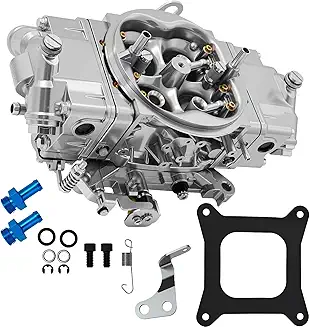
This is the race-bred aggressive option. “Mechanical” means there is a solid linkage connecting your foot to the rear barrels. When your foot goes to the floor, all four barrels open instantly.
- Why it’s called a Double Pumper: Because air moves faster than fuel, snapping all four barrels open instantly causes a massive lean spot (too much air, not enough gas). To fix this, these carbs have two accelerator pumps—one for the front, one for the back—to squirt a raw shot of fuel into the engine the moment you hit the gas.
- The Risk: If your engine isn’t spinning fast enough, or your car is too heavy to accelerate instantly, opening all four barrels at once will kill the airflow velocity. The engine will “bog” (fall on its face) before it picks back up.
Best For:
- Manual transmissions (you can keep the RPMs up with the clutch).
- Lightweight cars (T-Buckets, Novas, stripped racers).
- Deep rear gears (3.73, 4.11, and lower).
- High-stall torque converters (3000+ RPM stall).
The Dream Factory Verdict
The debate isn’t about which carb makes more peak horsepower on a dyno (they are usually within 5 HP of each other). The debate is about driveability.
Choose the Vacuum Secondary if: You want to cruise, do burnouts without stalling, and have a car that is snappy and responsive at stoplights. If you drive an automatic G-Body or a classic truck, this is your winner 9 times out of 10.
Choose the Double Pumper if: You are building a nasty street/strip car with a manual transmission or a high-stall converter, and you have the rear gears to back it up. You need a drivetrain that allows the engine to rev instantly to use this carb.
The Bottom Line
Don’t buy a part just because it sounds cool in a parking lot.
- Build for the Street: Go Vacuum.
- Build for the Strip: Go Mechanical.