The intake manifold is how your engine breathes. It takes the air and fuel from the carburetor and splits it into the eight cylinders.
When you open a Summit or Jegs catalog, you see two main types: Dual Plane and Single Plane.
Most beginners think “Single Plane looks like a race part, so it must be faster.” Wrong. Unless you live at 7,000 RPM, that “race part” will make your street car feel like a minivan off the line.
Here is the no-nonsense guide to picking the right lungs for your machine.
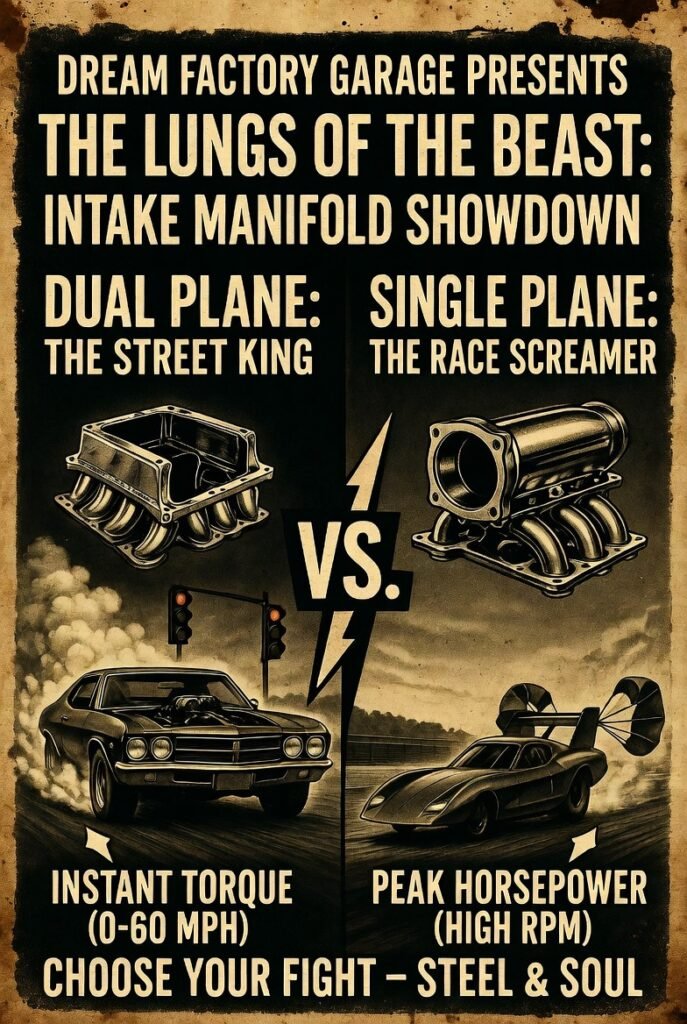
1. The Street King: The Dual Plane
The “Torque Factory”
If you look down into the carburetor mounting flange, you will see a divider wall splitting the opening into two separate sides.
- How it Works: It splits the engine’s firing order so the carburetor only feeds four cylinders on one side and four on the other. This keeps the intake runners long and narrow.
- The Physics: Long, narrow runners create Velocity (airspeed). Fast-moving air slams into the cylinders harder at low RPM, creating massive low-end torque.
- The Vibe: Snap your neck throttle response. Tires roast the second you touch the gas. The car feels “jumpy” and alive at stoplights.
- Best For:
- Heavy cars (Monte Carlos, Cutlasses, Trucks).
- Automatic transmissions with stock or mild converters.
- Engines that spend most of their time under 5,500 RPM.
- Examples: Edelbrock Performer RPM, Weiand Stealth.
The “Air Gap” Secret: You’ll often see “Air Gap” dual planes. These have a gap of air under the runners to keep the fuel cool (denser fuel = more power). This is the #1 choice for a street hot rod right now.
2. The Race Screamer: The Single Plane
The “Horsepower Hero”
If you look down the hole, it looks like a big open cavern. You can see straight to the bottom of the plenum. All eight cylinders draw from one big open chamber.
- How it Works: It has short, straight runners that minimize restriction. It prioritizes Volume over velocity.
- The Physics: It can flow a massive amount of air, but at low RPM, the air moves slowly (lazy). The engine will feel “mushy” or sluggish until you get the RPMs up high enough to get that air moving fast.
- The Vibe: Lazy off the line, but pulls like a freight train from 4,000 to 7,500 RPM. It’s a top-end monster.
- Best For:
- Lightweight cars (Novas, T-Buckets).
- Manual transmissions or high-stall automatics (3,500+ stall).
- Engines built to rev high and stay there.
- Examples: Edelbrock Victor Jr., Holley Strip Dominator.
The Dream Factory Verdict
The Mistake: A lot of new builders put a Single Plane intake on a heavy G-Body with a stock converter because they saw a dyno chart that showed it made 15 more horsepower at peak RPM.
- Result: The car is a dog on the street. It gets beat by minivans at traffic lights because it has no torque to get the heavy car moving.
The Fix:
- Build for the Stoplight: 90% of street races are won in the first 60 feet. You need Torque. Go Dual Plane.
- Build for the Trap Speed: If you are chasing a number on a timeslip and don’t care about cruising, Go Single Plane.
The Bottom Line
- Dual Plane = Street Fight (0-60 mph)
- Single Plane = Highway Pull (60-120 mph)
Steel & Soul – Dream Factory Garage